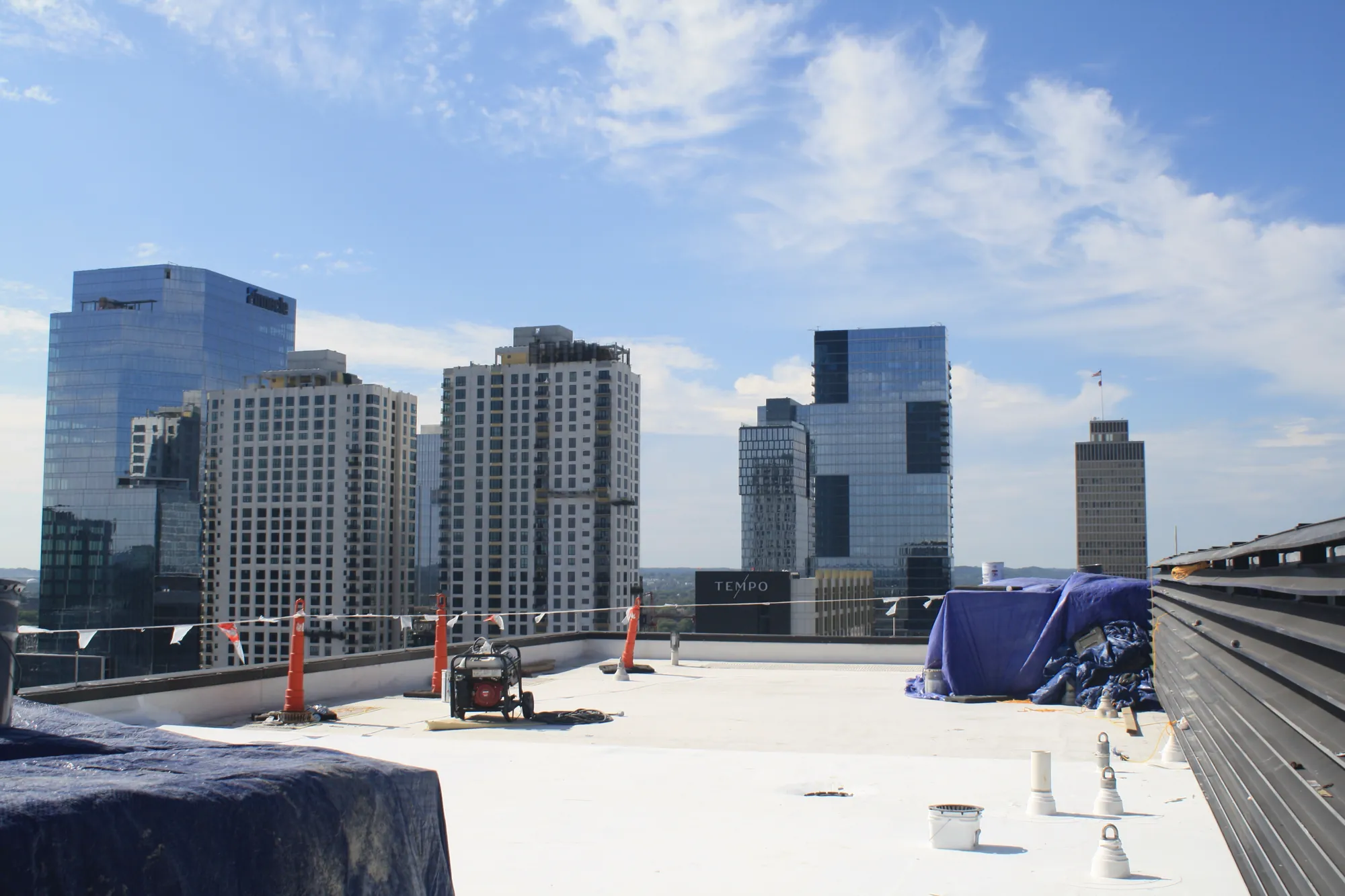
If you have ever looked up at a shopping center, warehouse, or office building and wondered why do commercial buildings have flat roofs when nearly every house has a steep, peaked one, you are asking one of the most common roofing questions we hear from Middle Tennessee property owners. The short answer is economics and practicality at scale: flat roofs are cheaper to build over a large footprint, faster to install, easier to maintain, and they turn the top of a building into usable space for HVAC and solar equipment. Here is the full picture from a Nashville commercial roofing contractor.
Why Do Commercial Buildings Have Flat Roofs? The Short Answer
A pitched roof works beautifully on a house, but it does not scale. As a building footprint grows from a few thousand square feet to tens of thousands, a sloped roof becomes dramatically more expensive, heavier, and harder to engineer. A flat (technically low-slope) roof solves that problem — it covers a huge area with less material, less structural framing, and less labor. That cost advantage, combined with the practical benefits below, is why flat roofs dominate commercial, industrial, and retail construction across Nashville and the surrounding region.
Lower Cost Over a Large Footprint
Roofing cost is driven largely by surface area and structural complexity. A pitched roof over a 50,000-square-foot warehouse would need enormous trusses, significantly more decking and roofing material, and far more labor to cover all that angled surface. A flat roof uses less material per square foot of building and rests on simpler, more economical structural framing. For a business watching its construction budget, that difference can add up to a substantial savings — which is the single biggest reason flat roofs are so common on commercial buildings.
Usable Space for HVAC, Solar, and Equipment
A flat commercial roof is valuable real estate. Large buildings need large mechanical systems, and a flat roof is the ideal place to put them. Rooftop HVAC units, condensers, exhaust fans, and ductwork can all sit out of sight and out of the way, freeing up interior square footage and ground-level space for the business. That same open, accessible surface is also perfect for mounting solar panel arrays — an increasingly popular upgrade for Tennessee businesses looking to cut energy costs.
Faster Installation and Easier Maintenance
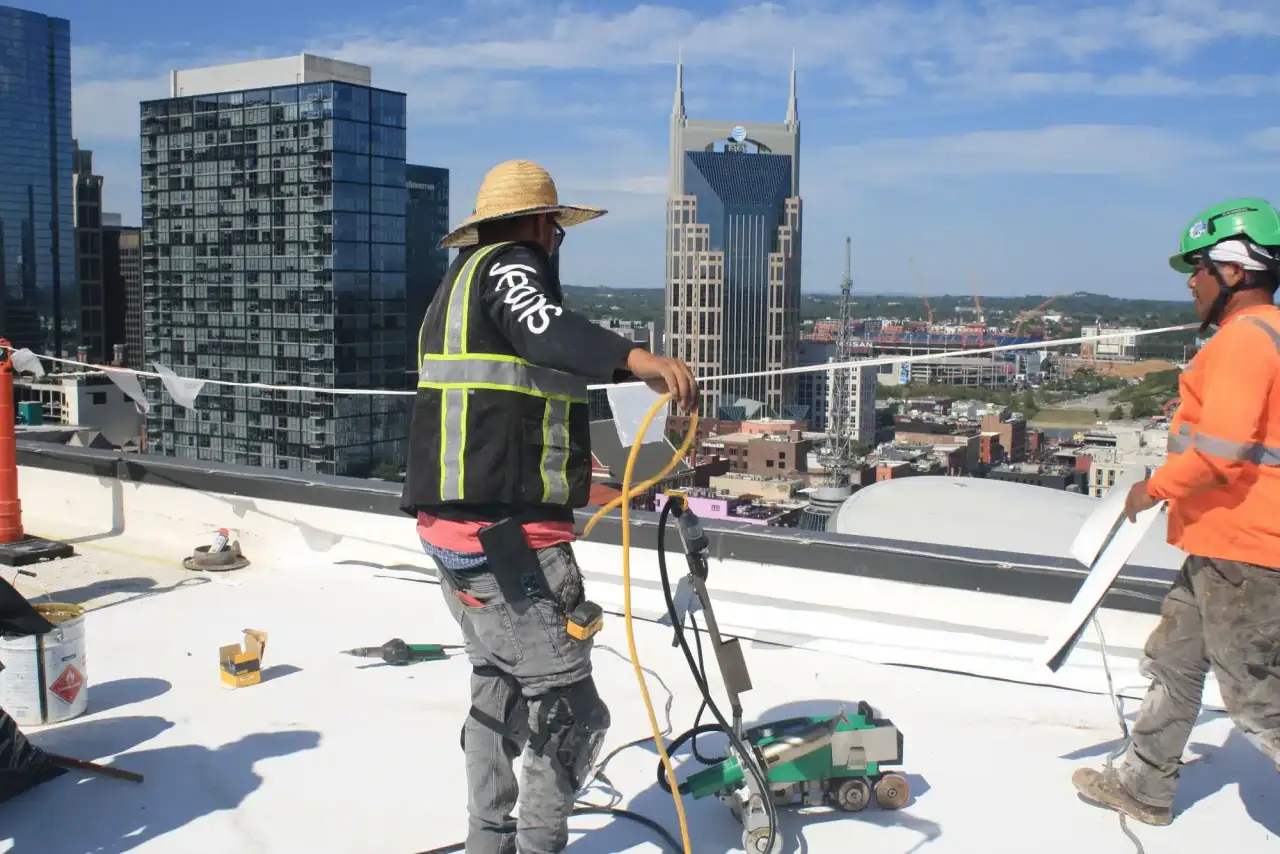
Modern single-ply membranes roll out across a large flat roof quickly, so installation is faster and less labor-intensive than shingling a complex sloped roof. Just as important, a flat roof is far safer and easier to service. Technicians can walk the surface to inspect seams, flashing, and drains, clear debris, and make repairs without specialized fall equipment on steep pitches. That accessibility keeps long-term maintenance costs down and makes routine inspections — the key to catching small problems before they become leaks — simple and affordable.
Flat Roofs Are Not Actually Flat: How They Drain
One of the biggest misconceptions about commercial roofs is that they are perfectly level. They are not. A well-built flat roof is given a slight slope — often around a quarter-inch of fall per foot, created with tapered insulation — so that water moves toward internal drains, scuppers, or gutters rather than sitting in place. Drainage is critical in Middle Tennessee, where heavy spring rains can dump several inches in a single storm. Standing water (called ponding) is the enemy of any flat roof, which is why proper slope, working drains, and regular inspections matter so much here.
Common Flat Roof Systems on Commercial Buildings
Not all flat roofs are built the same way. The most common commercial systems we install and service include:
- TPO (thermoplastic polyolefin): A bright white, heat-welded single-ply membrane that reflects sunlight and resists UV — a popular, energy-efficient choice for Nashville’s hot summers.
- EPDM (rubber membrane): A durable, long-lasting synthetic rubber known for weather resistance and flexibility in temperature swings.
- Modified bitumen: A multi-layer asphalt-based system that offers strong durability and is well suited to roofs with foot traffic.
- Built-up roofing (BUR): The traditional “tar and gravel” system of alternating layers — proven, heavy-duty protection for low-slope roofs.
Flat vs. Pitched: When Each Makes Sense
Pitched roofs are not unheard of in commercial construction — small retail buildings, restaurants, and offices sometimes use a slope for curb appeal or to match a residential neighborhood. But for the large, boxy footprints of warehouses, big-box stores, schools, and industrial facilities, a flat roof is almost always the smarter engineering and financial choice. Understanding why commercial buildings have flat roofs ultimately comes down to matching the roof to the building: flat for large footprints and rooftop equipment, pitched where appearance and a smaller scale allow.
Flat Commercial Roofing in Middle Tennessee
Nashville’s climate puts flat commercial roofs to the test — intense summer UV and heat, heavy spring downpours, and the occasional hailstorm all take their toll. Whether you need a new flat roof installed, a leak repaired, or an aging membrane replaced, Southern Roofing Co. has installed and serviced commercial flat roofs across Middle Tennessee since 1981. We work with leading manufacturers like GAF to deliver systems built for our climate.
Explore our commercial roofing services, or learn more about commercial roof replacement, commercial roof repair, and new commercial roof installation. Ready to talk about your building? Request a free estimate and one of our commercial specialists will take a look.