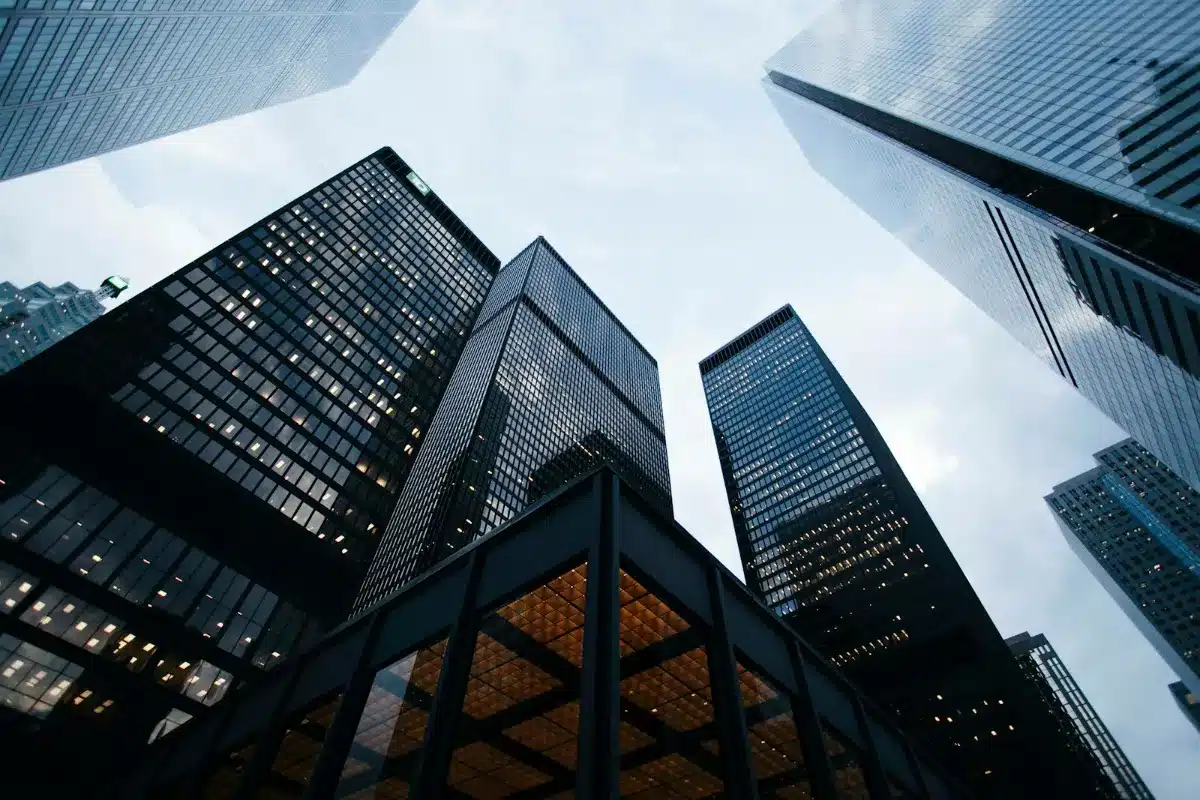
For commercial property owners across Nashville and Middle Tennessee, the roof is one of the largest — and most overlooked — drivers of a building’s operating costs. Long before a leak ever shows up, the design of a commercial roof is quietly deciding how hard your HVAC system works, how stable your indoor temperatures stay, and how much you pay to cool the building through a long Tennessee summer. Smart commercial building roof design is not just about keeping water out. It is about energy performance, comfort, and the long-term cost of owning the building.
Why commercial building roof design matters more in Middle Tennessee’s climate
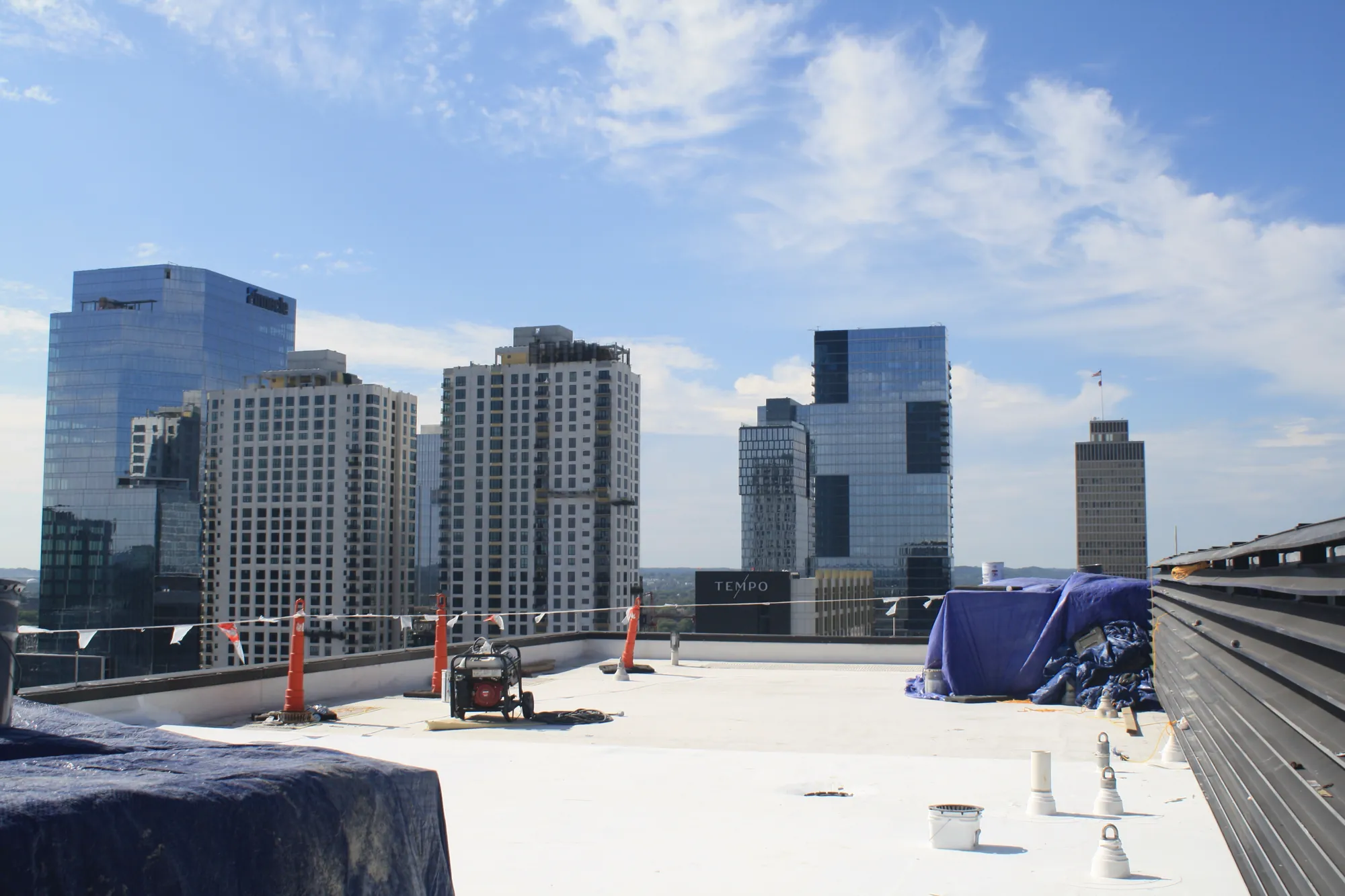
Nashville sits in a mixed-humid climate zone, which means commercial buildings here have to handle hot, humid summers and cold winter snaps in the same year. On a sunny summer afternoon, a dark, low-slope commercial roof can reach surface temperatures of 150 to 170°F. That heat radiates down through the roof assembly and into the building, forcing rooftop HVAC units to run longer and harder right when energy demand — and utility rates — tend to peak. Because most commercial buildings in our area use large flat or low-slope roofs, that sun-baked surface is often the single biggest source of unwanted heat gain in the entire structure.
Reflectivity: the case for a cool roof
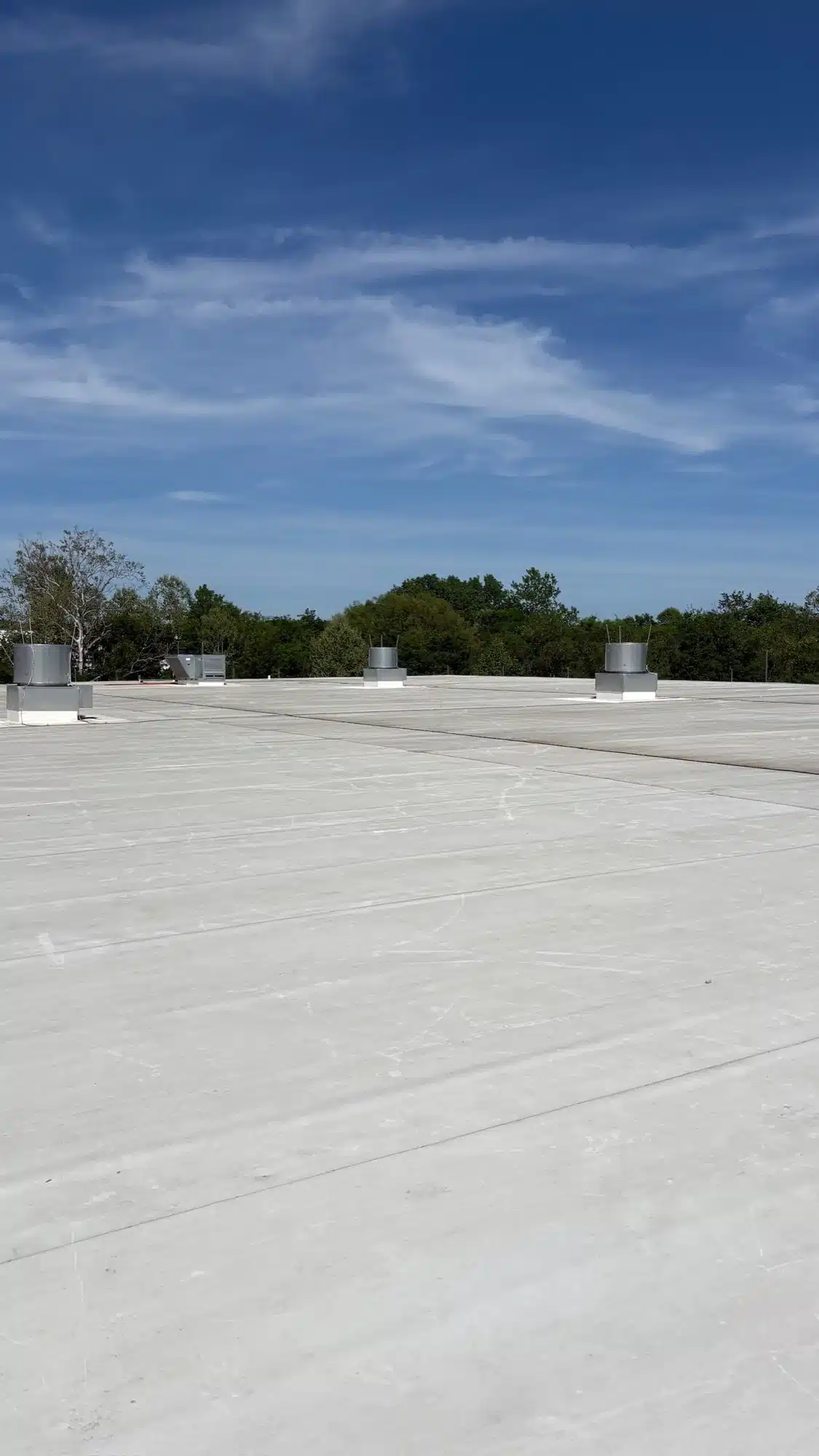
The most direct way commercial building roof design influences efficiency is through reflectivity. A standard white TPO membrane reflects roughly 80% of the sun’s energy, with solar reflectance values in the range of 0.80 to 0.88. A conventional dark EPDM membrane, by comparison, reflects only about 6 to 12%.
Under the same summer sun, a reflective “cool roof” often stays below 110°F while a dark roof bakes past 150°F. That difference translates directly into lower cooling loads. In warm climates, cool roofs can reduce cooling costs by roughly 10 to 30%, and the U.S. Department of Energy estimates annual savings of about $0.10 to $0.40 per square foot of conditioned roof area. On a 20,000-square-foot building, that range adds up quickly.
Insulation and the full roof assembly
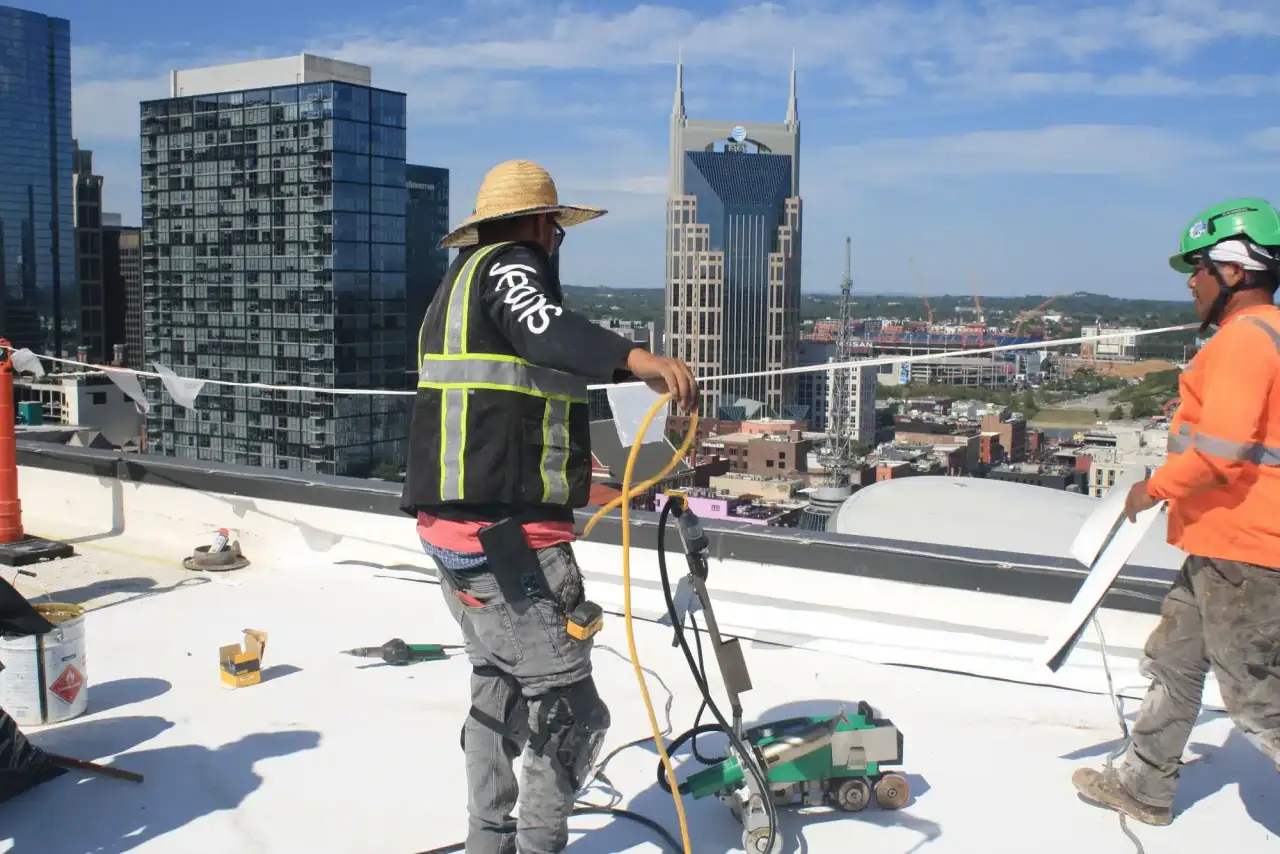
Reflectivity controls how much heat lands on your roof; insulation controls how much of it gets inside. A commercial roof is a system — membrane, cover board, insulation, and deck all working together. Adding continuous insulation to meet or exceed modern energy-code R-values keeps conditioned air where it belongs and reduces the temperature swings your HVAC has to fight. When a commercial building is being re-roofed, upgrading the insulation at the same time is one of the highest-return decisions an owner can make, because the labor to tear off and rebuild the assembly is already being spent.
Slope, drainage, and standing water
Middle Tennessee gets heavy, sustained rainfall, and flat commercial roofs are unforgiving about drainage. A roof that ponds water loses efficiency and lifespan fast: standing water degrades membranes, strains the structure, and creates cold spots that undermine insulation performance. Good design builds in positive slope — often through tapered insulation — plus adequately sized drains, scuppers, and overflow protection. Getting drainage right protects both the energy performance and the long-term durability of the roof.
Rooftop equipment, penetrations, and air leakage
Commercial roofs are crowded with HVAC units, vents, conduit, and dozens of penetrations. Every one of those is a potential path for air and water leakage that quietly erodes efficiency. Thoughtful design details the flashing and sealing around each penetration and positions equipment for easy service. Tightening up the roof envelope reduces the conditioned air that escapes and the humid outside air that sneaks in — a real factor during our muggy summers.
Choosing the right membrane for an efficient roof
Membrane choice is where commercial building roof design and energy performance meet most visibly. White TPO and PVC membranes are popular across Middle Tennessee precisely because their reflective surfaces fight summer heat gain. EPDM, often called rubber roofing, is durable and cost-effective but in its standard black form absorbs heat — though reflective EPDM options now exist. Modified bitumen and built-up systems can be finished with reflective coatings to improve their solar performance. The best choice balances reflectivity, durability, foot traffic, rooftop equipment, and budget for your particular building.
The mixed-climate trade-off, explained honestly
Because Nashville has real winters, a highly reflective roof carries a small heating-season trade-off: the same surface that rejects summer heat also reflects a little free solar warmth in January. For the vast majority of commercial buildings in Middle Tennessee, the long, cooling-dominated summer outweighs that winter penalty, and a cool-roof strategy comes out ahead on annual energy use. But the right answer depends on your building — its insulation, its use, and how it is conditioned. That is exactly the kind of judgment call a local roofing partner should help you make, rather than selling the same product to every property.
Rebates and incentives worth knowing about
Energy-efficient commercial building roof design can unlock savings beyond the utility meter. Reflective roofs that meet ENERGY STAR criteria may qualify for utility rebates or favorable treatment under energy codes, and pairing a cool roof with added insulation strengthens the case. Programs change, so it is worth asking your roofing contractor and your utility which current incentives apply before you finalize a re-roof. Even modest rebates shorten the payback period on the more efficient assembly.
Getting commercial building roof design right for your property
No two commercial buildings are identical, and good commercial building roof design starts with your specific structure — its size, orientation, insulation, rooftop equipment, and how the space is used. A warehouse, a medical office, and a retail strip each put different demands on the roof, and the most efficient assembly for one may be the wrong choice for another.
Before you sign off on a re-roof or new build, ask your roofer to walk you through the reflectivity rating of the membrane, the R-value of the insulation, how slope and drainage will be handled, and how every penetration will be sealed. A contractor who can answer those questions clearly treats commercial building roof design as an energy decision, not just a waterproofing job.
Keeping an efficient roof efficient over time
Even the best commercial building roof design loses ground if the roof is neglected. A reflective membrane that collects dirt, biological growth, and debris gradually loses some of its solar reflectance, which means a little of the cooling benefit fades each year. Periodic cleaning restores much of that performance, and it costs far less than the energy it saves.
Routine inspections matter just as much. Sealant at penetrations dries out, drains clog, insulation can take on moisture after a leak, and ponding areas develop as a roof settles. Catching these early protects both the waterproofing and the energy performance the assembly was designed to deliver. A simple schedule — a professional inspection twice a year and after major storms — keeps small problems from quietly raising your utility bills.
For commercial property owners, the most cost-effective approach pairs smart commercial building roof design at installation with a consistent maintenance plan afterward. The design sets the ceiling on how efficient your roof can be; maintenance determines how much of that efficiency you keep over the twenty-plus years you own the building.
Designing a roof that pays you back
A well-designed commercial roof keeps your building cooler, your HVAC bills lower, and your tenants more comfortable, all while lasting longer. Whether you are planning a re-roof, a new build, or simply trying to understand why your summer energy bills keep climbing, the commercial building roof design choices above are where the savings live. Southern Roofing Co. has served Nashville and Middle Tennessee for over 45 years, and we help commercial property owners weigh reflectivity, insulation, drainage, and budget to build a roof that fits their building. Thoughtful commercial building roof design is the difference between a roof that quietly drains your budget and one that pays you back year after year.
Commercial building roof design FAQ
Is a cool roof always the right choice in Tennessee?
For most commercial buildings in Middle Tennessee, yes — the long cooling season outweighs the small winter trade-off. But a building that is heating-dominated, heavily shaded, or unusually insulated may call for a different approach. The honest answer comes from evaluating your specific building, not a rule of thumb.
How much can better roof design actually save?
It depends on your building, but reflective cool roofs commonly cut cooling costs by 10 to 30 percent, and federal estimates put annual savings at roughly $0.10 to $0.40 per square foot of conditioned roof area. Pairing reflectivity with adequate insulation compounds those savings over the life of the roof.
Repair, recover, or replace for better efficiency?
If the existing membrane is sound, adding insulation and a reflective coating or a recover membrane can boost efficiency without a full tear-off. If the assembly is wet, failing, or near the end of its life, a full replacement is the better investment — and the ideal moment to build reflectivity, insulation, and proper drainage in from the start.
Ready to talk through your building’s roof? Explore our commercial roofing services or request an estimate to get started.